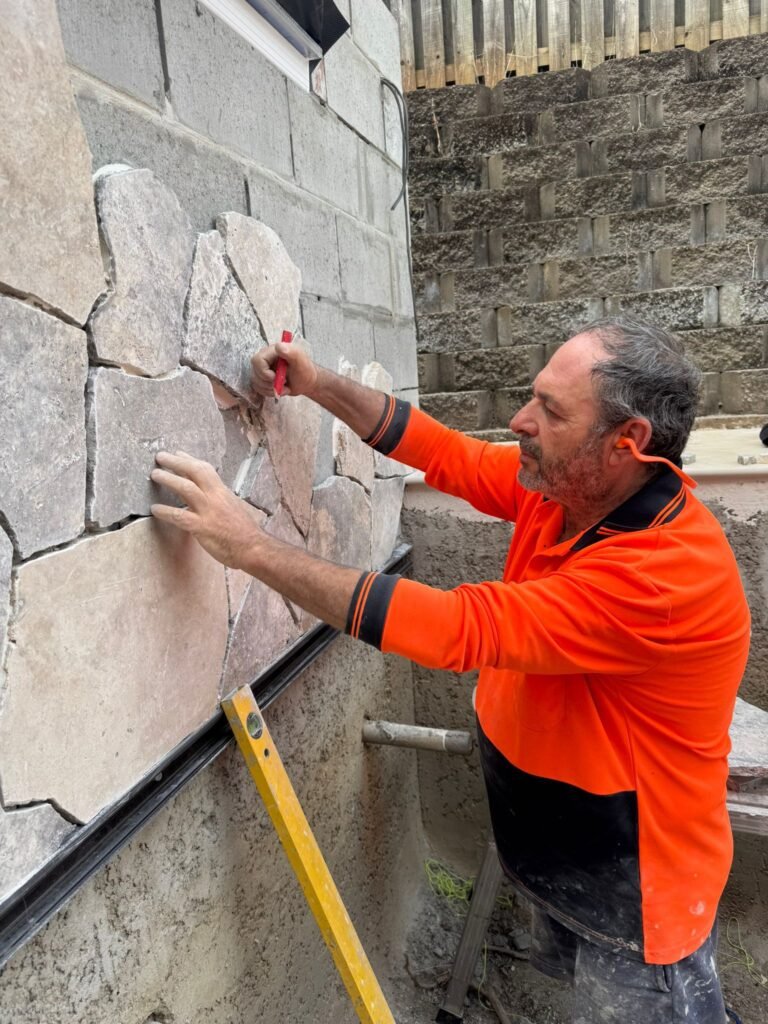
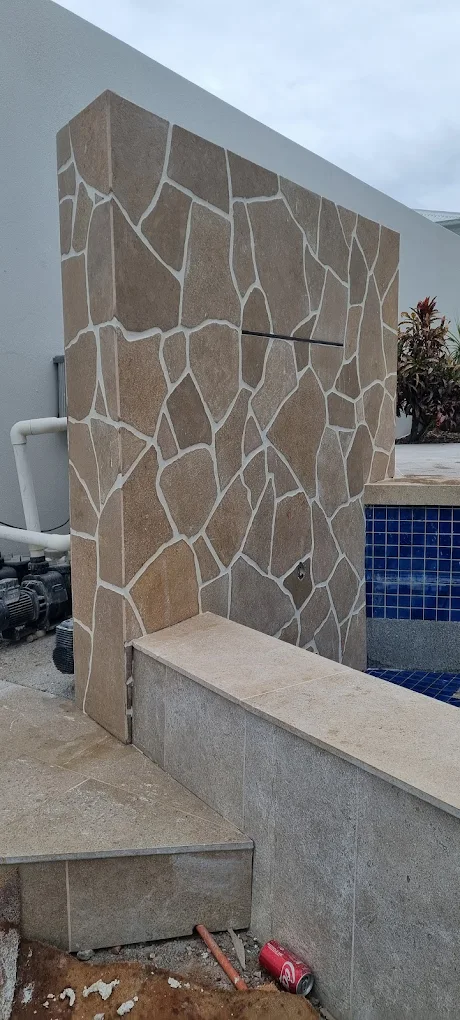
What is crazy paving?
Crazy paving is a tile or stone laid in irregular shapes — no square cuts, no straight grout lines. Each piece is hand-fitted to its neighbours so the joints flow organically. It's a strong look for paths, patios, feature walls and pool surrounds. The trade-off: it's labour-intensive and skill-dependent, which is why not many tilers offer it.
What materials work for crazy paving?
Natural stone is most common — bluestone, granite, sandstone, travertine — because the irregular shapes come from how the stone is split. Porcelain crazy-pavers are now widely available too; they look like stone but handle pool chemicals and stains better. We can show you both at the quote.
How do you keep the joints consistent?
We dry-lay every piece before any adhesive goes down. The joint width is balanced across the whole area — typically 8–15 mm depending on the stone — and we mix big pieces with small to avoid clusters of either. The grout colour is usually a darker tone that contrasts with the stone, so the joints read as part of the design rather than a flaw.
Can crazy paving be done over an existing concrete slab?
If the slab is sound, level, and bonded — yes. If the slab is cracking, has poor drainage, or has surface contamination, it'll need prep before crazy paving goes on top. We always assess the slab during the quote and list any prep as a separate line so you know what's included.
Is crazy paving slip-resistant?
Most natural-stone crazy paving is naturally slip-resistant when dry, and the irregular surface texture helps in the wet. Around pools or wet areas we still want a P4 or P5 rating, which most stone meets. Polished porcelain crazy-pavers should not go around pools — the polish removes the slip-resistance.
What's the maintenance like?
Stone crazy paving needs sealing every 1–3 years to resist staining and weathering. Porcelain is essentially zero-maintenance — a hose-off and a broom. The grout joints are low-maintenance for both: dark grout colours hide marks well, and the wider joints in crazy paving don't trap as much grime as narrow grout lines do.