The Sinnamon Park Case Study: Why a “Soft Spot” in Your Wall is a Termite Red Flag
When you look at the walls of your home, you expect to see solid plaster and a clean paint finish. But for a homeowner in Sinnamon Park recently, a closer look revealed a terrifying reality.
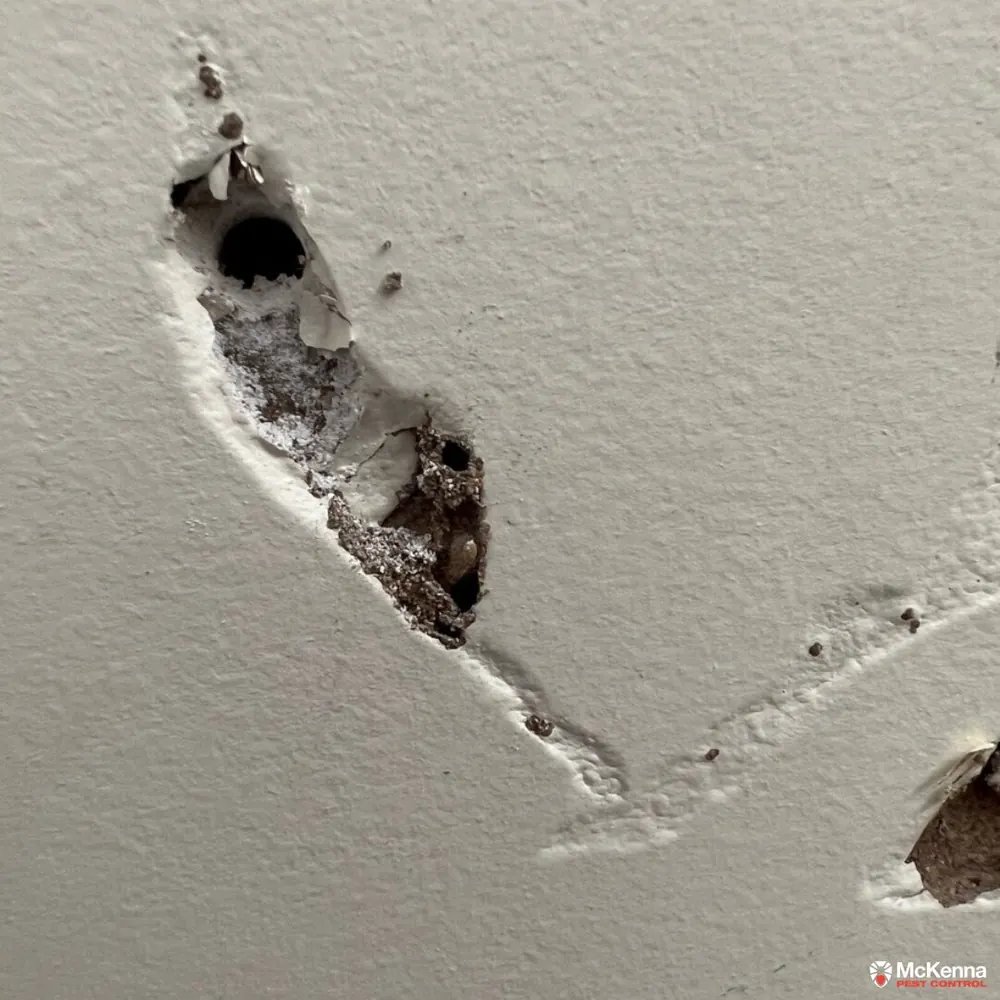
Instead of a simple scuff mark, they discovered a small breakout point where subterranean termites had actively eaten through the internal plasterboard and breached the surface paint.
This isn’t a stock photo from an overseas website—this is a real Brisbane property, and it perfectly illustrates how these “silent destroyers” operate in our local climate.
How Termites Move Invisible Behind the Paint
Subterranean termites are biologically driven to avoid light and open air because their soft bodies dry out quickly. To stay protected, they live entirely inside the dark, humid timber frames of your home or within mud tracking tubes they build along your foundations.
Because they eat structural timber from the inside out, they leave the outer layer of wood or paint intact as long as possible to preserve their microclimate.
By the time a colony breaches the surface paint—like the breakthrough point caught by our team at Jacaranda Close—the hidden structural timbers behind that plasterboard are typically already heavily compromised.
Why the “Soft Spot” Test Matters
Many Brisbane homeowners only realize they have a problem when they notice a localized change in their walls. Here are the three most common internal red flags that mean a colony is active inside your home:
The Soft Spot: Skirting boards, door frames, or window reveals that feel spongy, soft, or give way easily under light thumb pressure. Bubbling or Blistering Paint: This is often mistaken for water damage or a damp issue. In reality, it can be termites packing moist mud directly behind the paint layer. Hollow Sounds: Tapping a coin or your knuckle along structural timber or skirting boards and hearing a distinct, paper-thin hollow resonance.